




In short
The right viewing distance for an LED wall follows directly from its pixel pitch. The common factors: minimum distance ≈ pitch in millimetres × 1 (in metres), best-possible range ≈ × 2 to × 3, excellent from ≈ × 3.44 – the visual acuity distance. From there, an eye with normal 20/20 vision (resolving power of one arcminute) can physically no longer resolve individual pixels. Example P3.91: minimum around 4 m, best 8 – 12 m, excellent from about 13 m.
Why pitch dictates distance
An LED wall is made of discrete pixels with a fixed centre-to-centre spacing – the pixel pitch. Whether the image looks seamless depends on the angle at which two neighbouring pixels reach the eye. With normal 20/20 vision the human eye resolves structures down to about one arcminute – one sixtieth of a degree. If two pixels sit closer together than this angle, they merge into a continuous surface.
The calculator
Set your pitch – or work backwards from the planned distance to the right pitch:
Values assume normal visual acuity (20/20). Younger viewers at 20/16 – 20/12 resolve finer detail – when in doubt, plan one step finer. Content with small text additionally needs sufficient image height (see the DISCAS section).
The common factors at a glance
Four reference distances are established across the industry. All convert pitch in millimetres → distance in metres:
- × 0.5 – colour blending distance: from here the individual red, green and blue LEDs of a pixel merge into blended colours. Nobody should stand closer.
- × 1 – minimum distance: the common industry lower limit (“pitch in mm ≈ minimum distance in m”). The image is usable but the pixel structure is still visible.
- × 2 to × 3 – best-possible range: the practical recommendation for planning and purchase. The image looks seamless while the wall stays economical – a finer pitch would add hardly any visible benefit from this distance.
- × 3.44 – visual acuity distance (“excellent”): the scientifically derived limit: at one arcminute of resolving power, d = pitch ÷ tan(1′) ≈ pitch × 3,438 (result in mm, i.e. × 3.44 in metres). Beyond this distance the pixel structure is fundamentally invisible to 20/20 vision – the principle behind “retina” resolution.
In the US the 10× rule is also common: pitch in millimetres × 10 gives the distance in feet – roughly × 3.05 in metres, an approximation of the visual acuity distance.
Table: distances per pixel pitch
| Pitch | Colour blending from | Minimum distance | Best possible | Excellent from |
|---|---|---|---|---|
| P0.9 | 0.5 m | 0.9 m | 1.8 – 2.7 m | 3.1 m |
| P1.25 | 0.6 m | 1.2 m | 2.5 – 3.8 m | 4.3 m |
| P1.5 | 0.8 m | 1.5 m | 3 – 4.5 m | 5.2 m |
| P1.9 | 0.9 m | 1.9 m | 3.8 – 5.7 m | 6.5 m |
| P2.6 | 1.3 m | 2.6 m | 5.2 – 7.8 m | 8.9 m |
| P2.97 | 1.5 m | 3 m | 5.9 – 8.9 m | 10 m |
| P3.91 | 2 m | 3.9 m | 7.8 – 12 m | 13 m |
| P4.81 | 2.4 m | 4.8 m | 9.6 – 14 m | 17 m |
| P6.25 | 3.1 m | 6.2 m | 12 – 19 m | 21 m |
| P8 | 4 m | 8 m | 16 – 24 m | 28 m |
| P10 | 5 m | 10 m | 20 – 30 m | 34 m |
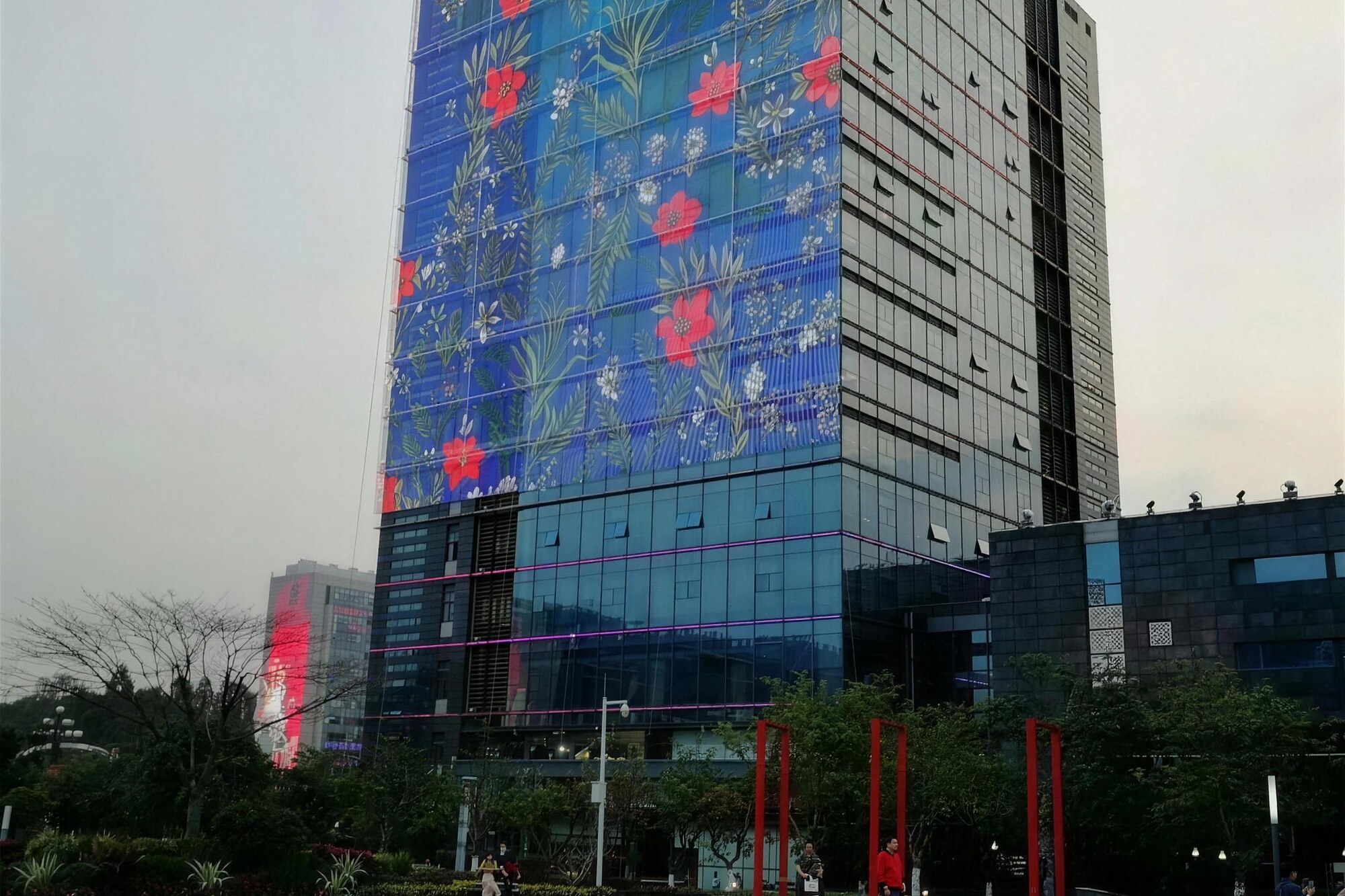
These values cover the WALED portfolio from fine-pitch conference walls (CONFERENCE RATIO, from P0.9) through rental systems such as AURA PRO (P1.9 – P3.91) to outdoor façades such as SIGNATURE SKYLINE (up to P10.42).
The scientific derivation
The basis is Snellen’s definition of visual acuity: 20/20 vision means the eye can still separate two points that appear at an angle of one arcminute (1/60 of a degree) – the way visual acuity is tested to this day (standardised in ISO 8596). Geometry then yields the distance from which a pixel grid becomes invisible:
d = p ÷ tan(1′) ≈ p × 3,438 (d and p in the same unit)
Psychophysical measurements confirm the magnitude: in 1965 Campbell and Green measured a resolving power of roughly 30 to 60 cycles per degree for the human eye – 60 cycles per degree corresponds exactly to the one-arcminute limit reached by young, very good eyes. Hence: to build in reserve for viewers with better than 20/20 vision, calculate with × 4.3 to × 5.5 instead of × 3.44 – or simply pick the next finer pitch.
What matters besides pitch
- Content: video and imagery are more forgiving than fine text or tables. For text, the image height matters alongside the pitch – the AV standard ANSI/AVIXA V202.01:2016 (DISCAS) defines image size and maximum viewing distances by content type.
- Brightness and environment: outdoors, luminance against daylight often matters more than a fine pitch – see Brightness & nits.
- Viewing angle: strongly off-axis viewers need panels with a wide viewing angle (WALED standard: 160°/160°).
- Budget: a finer pitch than necessary costs disproportionately more – beyond the visual acuity distance it adds no visible benefit.
Find the right pitch for your project in a few steps with the WALED LED wall configurator – or talk to us directly: we plan the viewing distance into every project.
Frequently asked questions – viewing distance
How do I calculate the optimal viewing distance of an LED wall?
Multiply the pixel pitch in millimetres by 2 to 3 – the result is the best-possible distance in metres. For P3.91 that is roughly 8 to 12 metres. The minimum distance uses factor 1; the visual acuity distance, beyond which individual pixels become invisible, uses factor 3.44.
What is the visual acuity (retina) distance?
The distance from which an eye with normal 20/20 vision (resolving power of one arcminute) can no longer separate two neighbouring pixels. It equals the pitch divided by the tangent of one arcminute – in practice: pitch in millimetres × 3.44 gives the distance in metres. For P2.6 that is about 9 metres.
Where does the factor 3,438 come from?
From the geometry of vision: 20/20 acuity corresponds to a resolving angle of one arcminute (1/60 of a degree). The reciprocal of the tangent of this angle is 3,437.75. A detail 1 millimetre in size therefore becomes unresolvable from about 3.44 metres. The definition goes back to Snellen’s acuity test and is standardised in ISO 8596.
Can the viewing distance become too large?
Not for the pixel structure – but for legibility. From far away it is the image height, not the pitch, that limits what remains recognisable. For text content, the AV standard ANSI/AVIXA V202.01:2016 (DISCAS) defines maximum distances depending on image height and content type. As a rule of thumb for readable presentations: maximum distance of about four to six times the image height.
Which pitch suits my viewing distance?
Divide the distance in metres by 3 to 2 – that gives the recommended pitch range in millimetres. At 6 metres, that is P2 to P3. If very sharp-eyed viewers also sit close to the wall, choose the next finer pitch. The WALED portfolio ranges from P0.9 to P31.2.
Sources and further reading
- F. W. Campbell, D. G. Green: Optical and retinal factors affecting visual resolution. The Journal of Physiology 181 (1965), pp. 576 – 593. DOI 10.1113/jphysiol.1965.sp007784
- Snellen visual acuity testing, standardised in ISO 8596 – Ophthalmic optics: Visual acuity testing (20/20 vision = one arcminute resolving angle).
- ISO 9241-303 – Ergonomics of human-system interaction: Requirements for electronic visual displays (character sizes and visual angles for displays).
- ANSI/AVIXA V202.01:2016: Display Image Size for 2D Content in Audiovisual Systems (DISCAS). avixa.org
- Kolb, Fernandez, Nelson (eds.): Webvision – Visual Acuity, University of Utah / NCBI Bookshelf. ncbi.nlm.nih.gov
- Planar Systems: Understanding Viewing Distance (white paper on visual acuity distance and the 10× rule). planar.com